#144 white dwarfs & black dwarfs

I’ve found that most of the people on this forum subscribe to an eternal universe without a beginning, yet according to mainstream astronomers and astrophysicists, white dwarf stars are supposed to cool into black dwarfs, but no black dwarfs have even been observed; mainstream scientists explain that this is because the universe is not old enough for any white dwarfs to have cooled into black dwarfs. How do we explain the absence of black dwarfs within the framework of a universe without a beginning?
1❤️ 1
I have the answer to that, at least in theory. It relates to a process in nature that I have written a lot about, that I call the Hubble luminosity. It suggests that the internal gravitational energy of a mass or a system of masses, U is steadily being converted to photons and heat at the rate L = -UH , where H is the Hubble constant. This process seems to reverse the general flow of gravity. You can think of it this way. Suppose that U actually consists of electromagnetic energy in a different, ‘hidden’ form. It is being converted to ‘real’ photons at the same rate that photons lose energy by the Hubble redshift.
You are correct that white dwarfs should cool down to black dwarfs in the standard description, but the Hubble luminosity prevents this from happening. The white dwarf and neutron stars are much brighter than theory can explain. That’s why astrophysicists invent so many arcane processes to heat them up.
The Hubble luminosity is also the key to a black hole universe, as the energy released inside a black hole prevents it from collapsing to a singularity. It acts as a form of Einstein’s cosmological constant lambda. The Hubble luminosity also explains plate tectonics in a different way.
Here is a paper I wrote about it and the figure in it:.
HubbleRedshift.pdf
Does the Hubble Redshift_Figure_1.pdf
@ExpEarth .
Does the Hubble redshift flip photons and gravitons? Yes, but not quite, in my opinion. Photons exist but gravitons do not. And IMO the Hubble redshift should be replaced by the Cosmic Microwave Background Radiation. Or, as it is properly stated in the paper: photon energy, chiefly in the form of CMBR photons. There is a lot in your proze I can agree with, but producing eloquent English is not my gig, so I would like to jump to one of the formulas.
$$ U \equiv -\frac{GM^2}{R} $$
where $U$ is the internal gravitational potential energy [ .. ] A proposal, which is underpinned by many physicists is a factor $2$ different from yours. Theory is found in Self Energy Field. It is formula (13) times $c^2$ with different symbols and a space coordinate going to infinity.
$$ U \equiv -\frac{GM^2}{2R} $$
However, even with that factor $1/2$ the double logarithmic (!) plot in your Fig. 1 wouldn’t show much difference, due to its enormous scale.
Whatever. My own theory has been inspired by yours. A final version of it is found in Penzias and Wilson doubted CMB as Big Bang relic and now 3/3 complete in Let there be CMB.
You’re close but not at all. And you are leaving out inherited curvature from the other layered dimensions necessary for gravity to act. It cannot act uniformly by itself. As for something being “eternal,” you’re adding time to describe space when time is not dimensional. Time emerges as the effect of the geometry of multidimensional space once given spin and rotation, period, end of story. If matter has no mass, then gravity has zero effect; sorry to blow up your model there.
@Icheb3891 :
Okay, 2pi. That was easy. What else you got? I would show my work, but you’re not ready for that. However, I invite you to my repository and see if you can come up with the first principle that explains the fractal symmetric structure to prime number gapping, that I have mapped. There’s no where near the space here to show all my derivations to show you how your error variances and infinities blow up in your face. So in response to your meme “SHUT UP and defend your assumptions of your first principles and calculate your defenses. Don’t cry when I fix your work.
@MJoseph315 I agree with @ExpEarth above. We just have to find another source of heat that solves this problem.
I found this reasonable explanation of heat dissipation, but still amazed at the slow decay and the timescales involved: White dwarfs are “dead cinders”
However, if the surface of an object in outer space remains ‘hot’, it means there must be a continous feed of heat and energy from inside, like e.g. a star. In the case of a star it can be understood because the process of heat generation continues. A white dwarf has ceased fusion activity, yet radiates almost as high a temperature as an active star and the cooling effect takes billions of years. My mind tells me it should cool down rapidly (relative of course, to my cup of tea), but it is not the case.
My opinion thus there is another source of heat we have yet to identify. Gravity certainly checks the box.
In addition to the above answers, there are many more reasons why we don’t observe them.
Given enough time (and there is always enough time in a static cosmology) heat will have enough time to dissipate and objects will have enough time to collide and be recycled into light and hydrogen.
Paul Laviolette has talked of the possiblity of alternative heat mechanisms in stars
I mean… that does seem like the most obvious scenario. There are plenty of black dwarfs out there. But they’re black, so… we don’t see ’em.
Louis, how can all objects in the universe eventually be converted into hydrogen, when the endpoint of fusion reactions in stars is Iron and other heavier elements?
Indeed the endpoint of fusion (and fission) is iron, as it is the element with the lowest energy (see graph). Iron is present in space in the form of dust. We constantly see iron meteorites fall into the Earth’s atmosphere, but it is difficult to see iron in space because it absorbs very little light.
Light released by stars is redshifted by electrons in the intergalactic medium (IGM). The energy lost by the photons heats up the electrons to temperatures reaching $10^{11}$ K. This high temperature ($10^{11}$ K $\rightarrow 9$ MeV/particle) is sufficient to give any particle an energy of $9$ MeV to produce, through fission, the lighter elements on the left-hand side of the graph up to hydrogen.
The process is:
We know there are high-energy particles in deep space, high-energy physics in the IGM is no surprise at all.
I copy below an earlier message (edited for clarity) from the forum about the high temperatures of plasmas in space and why that precludes the so-called “heat death of the universe”.
Louis, yours and Sahil’s hypotheses on fission occurring in the IGM is interesting, but is there any evidence that you can point to that supports the existence of this process?
Even if this process could induce fission in the IGM, I doubt it would induce fission in extreme stellar objects like black dwarfs. I also don’t see how it would affect solid stellar objects like meteorites and planets.
These processes are known and measured by nuclear physicists. Take this partial list of reactions with hydrogen and isotopes:
$^2_1D + ^3_1T$ → $^4_2He$ (3.52 MeV) $+ n^0$ (14.06 MeV) $^2_1D + ^2_1D$ → $^3_1T$ (1.01 MeV) $+ p^+$ (3.02 MeV) $^2_1D + ^2_1D$ → $^3_2He$ (0.82 MeV) $+ n^0$ (2.45 MeV) $^2_1D + ^3_2He$ → $^4_2He$ (3.6 MeV) $+ p^+$ (14.7 MeV) $^3_2He +^3_2He$ → $^4_2He + 2 p^+ +$ 12.9 MeV $^3_2He + ^3_1T$ → $^4_2He + p^+ + n^0 +$ 12.1 MeV $^2_1D + ^6_3Li$ → $2 ^4_2He +$ 22.4 MeV $^2_1D + ^6_3Li$ → $^3_2He + ^4_2He + n^0 +$ 2.56 MeV $^2_1D + ^6_3Li$ → $^7_3Li + p^+ +$ 5.0 MeV $^2_1D + ^6_3Li$ → $^7_4Be + n^0 +$ 3.4 MeV etc.
Since every reaction is reversible, it’s a matter of using the energy available in the hot IGM to produce the lighter elements from the heavier ones. For example, using some reactions above one can see how beryllium, lithium and energy are transformed into the lighter elements tritium and deuterium: $^7_4Be + n^0 +$ 3.4 MeV → $^2_1D + ^6_3Li$ $^7_3Li + p^+ +$ 5.0 MeV → $^2_1D + ^6_3Li$ $^2_1D + ^6_3Li$ → $2 ^4_2He +$ 22.4 MeV $^4_2He$ (3.52 MeV) $+ n^0$ (14.06 MeV) → $^2_1D + ^3_1T$
These reactions have been studied for all elements, so the process of using energy and heavy nuclei to produce the light nuclei is experimentally confirmed.
Extreme stellar objects like black dwarfs and rocks are bound together by gravity and electric forces, which are both very weak forces compared to the nuclear force (see table below). High energy particles easily eat away at rocks and black dwarfs in the same way the air from the atmosphere causes ablation of the surface of a meteor (i.e. it burns up and disappears).
“Cosmic nuclear fission seen for 1st time in ‘incredibly profound’ discovery” https://www.space.com/nuclear-fission-neutron-stars-heavy-elements-gold Now they are starting to see fission of heavy elements in space. With more sensitive detection, the fission process I describe above will be confirmed observationally. 👀
High energy particles come from traveling through interstellar space where interrupting or interfering waves are at a minimum so they are able to amplify their wavelengths even appearing to travel faster than they actually are as the peak intensity can travel ahead of the actual particle. It’s quite simple logic, really.
The fission process is just space inverting the curvature of an atoms nucleus decoupling them apart. This also explains why so much more output in energy happens with fission than with fusion. It takes much more energy to invert curvature than it does to propagate it.
Black dwarfs could be a fraction of elusive dark matter. Is to say, maybe we can not detect these objects.
We don’t know,so far these objects or fragments of them haven’t been discovered
‘Black Dwarfs’ may not be so easily detected, but there are plenty of ‘Brown Dwarfs’ around.
Here is another temperature anomaly. Wait. How can this brown dwarf be hotter than our sun?
My next question would be how can the White Dwarf be hotter than our sun? A White Dwarf is only the remaining hot core of a ‘used to be sun’ not unlike our own. IOW not e.g. a blue star.
Considering that a white dwarf has ceased fusion, and lost its outer layers, and is in the process of cooling down, how does it still radiate hotter than our sun? Not only that; now it radiates at $1/r^2$ away and the surface of the Brown Dwarf is also still hotter than our sun.
There is the argument that radiation takes M-years to exit the object, but this is starting more to look like a fudge to me. If it takes that long to exit, the exponential drop-off curve must be huge.
Paul LaViolette’s writins might have an answer
@Francois-Zinserling The brown dwarf in their study is not a good example for illustrating intrinsic heating in brown dwarfs, as it is orbiting a white dwarf. White dwarfs have very high luminosities, which can be accounted for using the Hubble luminosity equation. The brown dwarf here has a much higher surface temperature in the side facing the star than in the side facing away. This shows it. To study the brown dwarf luminosities, you need to use more isolated stars.
@bgreenman Paul LaViolette had an equation for intrinsic heating of stars and planets that looked identical to my Hubble luminosity equation, L = UH , but in his equation H referred to the thermodynamic term. In my equation H is the Hubble constant. My equation predicts the luminosities far better than his.
Check my graph from earlier in this thread!
No offense, but Paul Laviolette’s ideas about ‘intrinsic heating’, ‘continuous creation’, and planets gradually transforming into stars seem a little too outlandish to me.
Maybe with the availability of supercomputers and AI programs we could try to simulate various theories aboout the internal processes of white dwarfs, until a satellite can’t be launched thats in an orbit farther out in the solar system
What if our Earth is a black dwarf?
Possibly not, since their have been many exoplanet discoveries, unless we find evidence of unknown solar system history
First assumption, these objects are undetectable. Second assumption, our galaxy can be young.
I Agree With the first,the Second i’m not sure
@RedshiftDrift
Louis, I’m surprised that you would have the light elements being recreated in space, when the easier route is for them to be made inside supermassive black holes (SMBHs). There is more than enough energy inside those to blast the heavier elements apart and there is evidence of the protons being returned back to space in jetting processes. This was part of Arp’s model, right?
An idea worth investigating
I don’t recall that was part of Arp’s model, but I might have missed this. In any case Arp’s models don’t work1, only his observations of quasar-galaxy associations turned out to be correct. There is also no evidence of the existence of SMBHs; only dense objects are known to exist at the centre of galaxies. At their core, just like inside stars, these high density objects fuse light elements, and fission the heavier ones, bringing element abundances toward Fe as the object produces a net energy output.
Astronomers think that the ‘IGM plasma’ is at a temperature ranging from 10000 K to 100000 K, and that stars and “black holes” swallow dust from “accretion disks” to produce jets. Because the IGM is too tenous to be observed directly, they can’t think that it is the major contribution to matter drained by massive objects. As a result, astronomers are still confused about what produces the jets, as you can read in this article and many others: “We still don’t know what powers these jets”.
Yet we know from dispersion in FRB radio signals that the IGM plasma is present and we even measure its density. However, without a TL redshift model it’s impossible to know that the IGM is much hotter than $10^5$ K! So models used by astronomers are backwards. These “jet” models are pure sci-fi fantasy, not evidence at all of matter being ejected.
What really happens is that stars and other massive objects all produce heavy elements because the temperature of their core is colder than the theoretical upper limit of about 6 billion kelvin, not high enough for fission (white dwarfs are even colder because they are dead cinders). The “jets” we see around massive objects are formed by light elements spiralling in towards the massive object (see images below for an analogy). The heavier elements, dust and planets (that orbit the massive object) are ejected out by centrifugal forces through the “dust disk” (and planetary system) that contains heavy elements. Galaxies and stars are giant centrifuges that expel heavy elements into surrounding space.
Only the low density and high temperature of the IGM at 100 billion kelvin allows convertion back to light elements.
$—–$ These so-called “jets” are actually drains. https://youtu.be/V0jvhDL0iFE?t=16 and https://ned.ipac.caltech.edu/level5/Sept09/Worrall/Worrall1.html
See e.g. message in ACG Alt Observable, Fri, 24 Apr 2020 03:00:02 UTC
A great start to find out how the elements are created
@ExpEarth >supermassive black holes (SMBHs) This was part of Arp’s model, right?
Supermassive black holes have never been part of Arp’s model. Arp has even suggested there may be white holes rather than black holes in the center of galaxies, whatever that might mean.
@RedshiftDrift >In any case Arp’s models don’t work
As if models can never be improved once they have been conceived by an abandoned individual who’s only sin is that he wasn’t good at mathematics.
Leaving all objections aside, here comes the part that I’ve been dreaming of for some time, but @RedshiftDrift (I think) is the first one to formulate it, loud and clear:
YES !! That could be the missing link for our MOND = UAC theory about the flat velocity profiles in galaxies.
The Wikipedia webpage about Non-standard cosmology says the following at the end of the linked section. Halton Arp has proposed an explanation for his observations by a Machian “variable mass hypothesis”. The variable-mass theory invokes constant matter creation from active galactic nuclei. In the named section at my website it is postulated, accordingly, that Variable Mass is proportional to the distance from the center of the galaxy. It would be nice if that creation out of nothingness could be replaced by some energy source pouring in from outside. This could be provided by a mechanism as proposed by Louis: the galaxy sucks light elements towards its center and then spews them out as heavier matter into its arms. This is a very crude idea, but certainly worthwile to investigate further.
@RedshiftDrift
I was referring to Arp’s idea that matter is ejected from the cores of galaxies to become new galaxies. The daughter galaxies have higher redshifts as the matter in them is all ‘young matter’ with lower mass. I can’t recall if Arp thought these were ejected as discrete pieces or if they arose as condensates of jetted hydrogen.
I use the term SMBHs somewhat generically, as you’re right that the objects have not been confirmed as actual black holes (with singularity, etc.). There are many alternative models for the smaller type black hole-objects, such as gravastars and dark energy stars. Some of these do not have a singularity or an event horizon. Though we don’t know precisely what they are yet, either the small or the large ones, I think the terms ‘black holes’ and ‘SMBHs’ are still useful handles. I do think they have some of the black hole properties, such as the mass-radius relationship. But what you say about fusion ongoing in these objects is news to me. I haven’t seen anyone else calling for that.
I’ve included an image from Wikipedia as to how these objects are viewed. My current thinking is that what we call the AGN disc or torus is the actual ‘black hole’, ie., there is not a smaller, dense structure inside.
I know I won’t convince you on this, but there is another source of energy to consider, the Hubble luminosity. The energy output from that is L = -UH , where U is the internal gravitational potential energy and H is the Hubble constant. I think I mentioned it in this thread. I have calculated that Sagittarius A*, the SMBH at the centre of our galaxy, would indeed have a temperature in the billion K range. Its peak blackbody wavelength would therefore be ~ 1 pm, i.e., in the gamma ray band. This radiation could conceivably give rise to some of the GRB-type phenomena.
I haven’t heard of this before. I’ll check out the videos.
@RedshiftDrift how are you sure that the jets are drains? There is evidence that jets are outflows, of matter and radiation moving away from the explosion. https://youtu.be/RXUy0StPeFs?si=fciBl7Iw6w-ipl-3&t=80 https://www.youtube.com/watch?v=zxqQ4G0NOhI&ab_channel=NASAGoddard also this earlier post of yours https://github.com/orgs/a-cosmology-group/discussions/141#discussioncomment-7023318
@sahil5d . Those two videos are animations, NOT observations. NASA is continuously misleading the public by mixing up the latter two. (And why would @RedshiftDrift not be allowed to change his mind?)
Sure, the animations are not proof. But these parts are important:
From the video on the collision of neutron stars: “The data suggests the blast’s shockwave traveled along a narrow beam confined by powerful magnetic fields. The resulting jet smashed into and swept up material in the surrounding interstellar medium. This material included a mass of radiation through which the jet emerged. As the jet moved away from the site of the explosion, the mass moved outward.”
From the video on the Milky Way’s central supermassive object: “NASA’s Hubble Space Telescope hasn’t photographed the phantom jet yet, but it has helped find circumstantial evidence that the jet is still pushing feebly into a huge hydrogen cloud.”
Are either of these or both of these wrong?
There is also M87’s central supermassive object: https://www.youtube.com/watch?v=n97-28mHeRs&ab_channel=NASAGoddard “And it’s been known for quite a long time that there was this little thing of brightness that was spewing away from it.”
I figured it out a long time before the post. I didn’t change my mind, a word is missing: “the appearance of jets”.
How are they sure the drains are jets? “The data suggests… “ because it fits their “jet” model, but despite the thousands of papers and drawings, there’s no more evidence for “jets” than there is evidence for Santa. Nobody has ruled out a plasma drain.
This type of observation is difficult to interpret because in a drain, the plasma’s rotational speeds exceed the velocity along the axis to the massive object. A rotating plasma produces both a blue and a red Doppler shift, but relativistic beaming increases the luminosity of the blue-shifted spiralling plasma. Often, the massive nucleus will have only one jet because of the asymmetric distribution of infalling matter. (When interpreted as a “jet”, this gives the impression that the plasma is moving toward us and relativistic beaming makes the counter “jet” invisible.)
While drains are natural phenomena generated by gravity and magnetic lines in a plasma, a contrived model is needed to produce “jets” and we still “don’t fully understand how this acceleration process [to produce jets] occurs…
Another argument in favour of a drain is the appearance of “shock bows”. Astronomers often “suggest” that an explosion happened millions of years ago, but what caused the explosion always remains a mystery. Interpreted as a drain, these glowing regions are stationary (another word you won’t like @sahil5d ;-) and well understood (see images below). They occur at the location where the infalling particles reach a high enough energy to produce a glowing plasma.
Look at these pictures and convince me that these are not infalling particles on a central massive object, with drains produced by the focusing action of magnetic fields and bows produced by infalling particles reaching a sufficient energy. With a plasma drain model these observations are no mystery and all understood with regular lab physics instead of contrived “jet models”. It’s time to go against mainstream and tell people to stop believing in Santa.
Real photo from here with lines added showing the direction of falling plasma and ejected matter. The infalling light-elements are converted to heavy elements by the stars of the galaxy and ejected as ‘dust’, clearly visible as dark lanes at the periphery of the rotating galactic disk.
Glow discharge regions from here. The video shows the stationary discharge in action.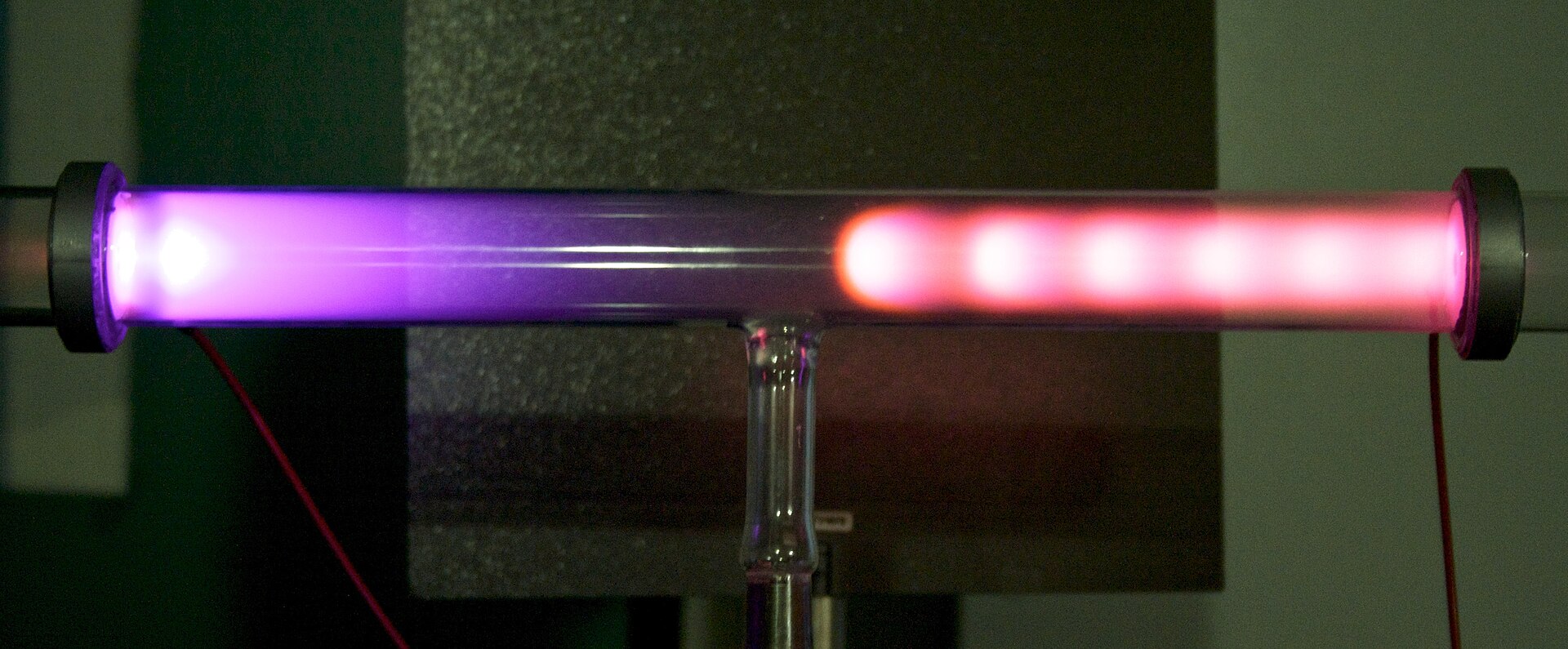
The Fermi Bubbles of our Milky Way from here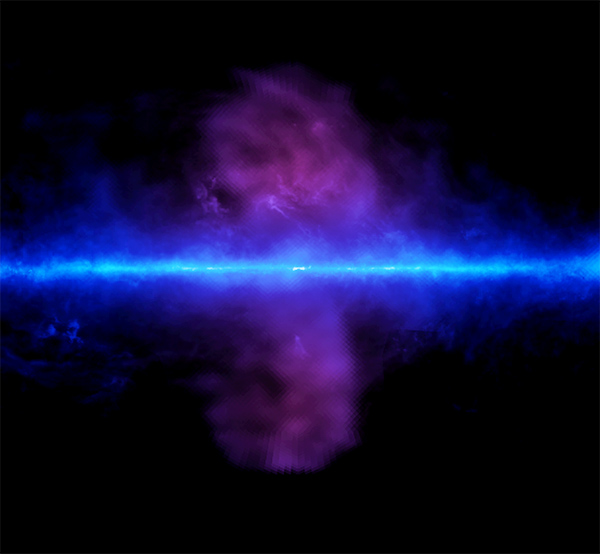
@sahil5d . Take good notice of those words of yours: collision, blast, smashed, explosion [ .. ] In short: you are parroting the paradigm of violence here. Now it’s a matter of perpetual brainwashing to make everybody believe in it.
Yet, if I look up into the sky, the only thing I see is a quiet, peaceful cosmos all over the place. Perhaps a good Christmas thought?
What about pulsars? They emit radiation out of their magnetic poles. There are also accretion-powered pulsars, https://en.wikipedia.org/wiki/X-ray_pulsar.
I partially understand the arguments for the drain, but I don’t fully understand the arguments against the jet.
Re the image of Centaurus A, tbh I can’t tell for sure. To me, it’s like a Necker cube.
Also, I don’t understand the centrifuge argument. Aren’t centrifugal forces fictitious? In a supernova, the heavier elements are expelled, but why would they be expelled farther than lighter elements?? I would think the lighter elements are expelled farther. Galaxies are not like centrifuge devices in that they don’t have a boundary on which heavier elements collect.
There is no argument against the jets, there are only better arguments in favour of drains.
For pulsars the description says:
so matter falls on pulsars exactly like the arrows added on the picture I copy below. Emitting radiation is not like emitting matter, comparing the two is a false equivalence fallacy. Once radiation leaves the source it travels along a straight line and is not held back by gravity or electric fields.
Light elements fall at the centre of the galaxy and are converted into heavy elements by the stars as they fly away from the centre. The centrifuge [machine] is a metaphor for the galaxy, obviously I am not saying that heavy elements are ‘centrifuged out of the galaxy’ faster than light elements! Perhaps this video will help visualizing the spiral arms of a galaxy ejecting matter. Of course, the yellow marbles in the video do not produce heavy elements like stars do, so the video is not an exact description of the galactic process.
Re pulsars, aren’t these jets of matter? https://youtu.be/M8DmwNvtfxk
Re galaxies, doesn’t this timelapse show that plasma is moving away from the galaxy center? https://youtu.be/n97-28mHeRs?t=31
Interestingly, the Vela Pulsar’s plasma and the M87 central object’s plasma are both helical. https://youtu.be/hzJseKd3a4A?t=41
Re the galactic spiral arms and analogy to flung marbles, that is in contradiction to the current theory of density waves, right? https://youtu.be/wIkOu45PHdA https://youtu.be/lMReQ6hVw5s Isn’t the density wave idea fairly complete? Also, in my estimation, the flung marbles analogy does not lead to orbits. A working model should have stars making maybe 10 to 100 stable orbits.
It’s always possible to find counter examples. There is no argument against the jets, there are only better arguments in favour of drains.
The marbles analogy doesn’t lead to orbits because gravity is not large enough compared to velocity. Again, it’s an approximation of parts of the much more complex problem.
The density wave idea for galaxies is not widely accepted, it is still poorly understood as a model. But density waves are frequently observed in nature and they can propagate in the opposite direction of the flow of matter. The interpretation of all these examples is therefore model dependent, and the density wave interpretation can be used to explain drains instead of jets.
Unless a way is visualised for a black hole to release matter in some form, jets as drains would argue for a swift death of galaxies. It makes more sense to me that matter is gravitationally absorbed, then released under a different mechanism, possibly where the matter is temporarily ‘massless’ and able to escape the gravity well.
Evolution of galaxies
This research, although it does not set out to provide ‘alternate science’ could be considered proof that galaxies are self-sustaining. My argument would be - if they weren’t self sustained - there should be old supermassive black holes with tiny (remains of) galaxies, and there should be (young) supermassive galaxies with tiny black holes. According to this study, there aren’t, which in my opinion suggests a recycle mechanism at play.
Nobody has ever spotted a black spot in the center of galaxy. Except in an artist impression.
About the Fermi Bubbles/eROSITA bubbles discussed above here and here that were claimed to have been produced by matter released by the black hole at the center of the Milky Way,
Watch Anton Pertov’s entire video “Mind-blowing New Discoveries About the Milky Way Galaxy” https://youtu.be/4PH_Edt2fQ0 and read the abstract of the paper. These results disprove the claim that the bubbles came from black hole activity.
Black holes didn’t release matter to create the Fermi Bubbles. Instead, infalling matter triggers star formation. Black holes don’t produce these jets either. They’re not jets, they are drains!
My model of a centrifuge galaxy is being confirmed, one small step at a time.
This footnote on page 2 https://arxiv.org/pdf/2408.06312 says something different.
Also, the video here https://youtu.be/n97-28mHeRs?t=37, examined frame by frame, looks like matter moving away.
these jets show jets 23m ly from end-to-end.
Before we get onto ‘drains’, what was most profound for me is that this structure stood relatively still, as in - not wobbling - for at least 23m years. Much more of course.
Just working on time-lapses for different scenarios. Let’s say:
My feeble vote goes against drains.
Edit … 23m ly end to end means all times above should be halved. This is why I should not become an accountant.
Drains are not produced this way. Ions falling into the drain produce a magnetic field that [“pinches”] (https://en.wikipedia.org/wiki/Pinch_(plasma_physics)) the drain to make it very thin. This self induced structure has no need for a spinning central object, it only falls on it because of gravity. This is how stable structures 23 Mly long (not 23 mly) can remain stable for so long.
Why the 👎 on https://youtu.be/n97-28mHeRs?t=37 ?
The gravitational acceleration 10 Mly away from a galaxy would be < 10^-10 m/s^2. How would that cause such a high-velocity, near-c drain?
And stepping back, when a galactic phenomenon like https://public.nrao.edu/gallery/hercules-a
closely resembles a pulsar jet like this https://youtu.be/pIoDD_TDsZI?si=gdUm4YzXyBgYQ9kx,
it’s very plausible the galactic phenomenon is a bigger version of what’s happening with the pulsar.
You’re reaching Louis. 23m ly is not the same as 23 mly.
I like the pinch phenomenon. It could begin to explain 1 jet (infalling). This is a good hypothesis but what makes the lines special?
I would say although the magnetic field will pinch a narrow beam, it does not assist with the infall - as in it does not ‘attract’ ions down into the funnel. That remains the work of gravity.
But as @sahil5d also mentions, you need to be able to generate X-Rays from the infall 23/2 MLY away, where the attraction and acceleration is still tiny. Then you need to explain why matter is only falling in on this line and what happens to the infall from say 90 degrees off? Why are there not multiple lines like on a lightning ball at the science fair? And next (probably not lastly) how are infalling lines exactly opposite to each other if it doesn’t originate from the central object?
@sahil5d . It seems to me that your second picture is an animation again, not an observation. So what does it prove?
@Francois-Zinserling writes: >Before we get onto ‘drains’, what was most profound for me is that this structure stood relatively still [ .. ]
Standing still would mean that this structure is not rotating around its axis. Hence there is no vortex. Right?
However, what worries me more is the relatively small size of the - supergiant ! - Hercules A galaxy, when compared with the jets-or-drains-or-whatever, as shown in the first picture by @sahil5d . And I think it’s important to notice that the jets / drains are only “visible” when imaged in radio waves. There are no X-rays in them. Right?
I have a question: are those jets / drains perpendicular to the plane of the galaxy?
Because in that case, there might be an explanation. Gravity can be compared with static electricity. Replace masses $m$ by charges $q$ and $G$ by $1/(4\pi\epsilon_0)$ in
$$ F = G\frac{m_1 m_2}{r^2} \quad \Longleftrightarrow \quad F = \frac{1}{4\pi\epsilon_0}\frac{q_1 q_2}{r^2} $$
The idealization of a galaxy could be a round, flat, gravitating plate. But it’s easier to find references for the electrical analogue. We have got some pictures from the internet and a webpage called Anomalous value of electric field due to a uniformly charged disc at a point on its central axis. At a point on its central axis is nice, because in that case an analytical solution can be obtained easily. The pictures show that numerical solutions are feasible for the whole electrical field though. I could do it myself, but don’t know if it is worth the effort. By the way, you should reverse the (push) arrows in both pictures below for getting (pull) gravitation. It is seen then that there is always a (feeble?) force component which is directed toward the axis. And the latter is perpendicular to the disk. Hence the above question.

Update
From the PHYSICS reference we copy, cast in gravitational terms
$$ g = G \sigma 2\pi \left[1 - \frac{z}{\sqrt{z^2+R^2}}\right] $$
where $g=$ acceleration, $G=$ gravitational constant, $\sigma=$ mass surface density of galaxy disk, $z=$ distance from galaxy along the axis through its center and perpendicular to the disk, $R=$ radius of galaxy. There are two interesting limiting cases
$$ R \gg z \quad \Longrightarrow \quad g \approx G \sigma 2\pi $$
For small distances, the gravitational acceleration is independent of the distance $z$ to the disk.
$$ R \ll z \quad \Longrightarrow \quad g = G \sigma 2\pi \left[1-\left(1+(R/z)^2\right)^{-1/2}\right] \approx G \sigma 2\pi \left[1-\left(1-\frac{1}{2}(R/z)^2\right)\right] = \frac{G \sigma \pi R^2}{z^2} $$
where $\sigma \pi R^2 = M$ is the total mass of the galaxy, considered as a point mass, and $z$ is the distance to that mass. In a sketch of the function we see that the (black) field of a disk indeed becomes indistinguishable from the (red) field of a point mass at approximately $z=2/5$ of the galaxy radius.
@sahil5d Your senses are fooling you. 👎 for confusing the motion of the wave with the motion of the medium: they are not the same.
https://youtu.be/7DAhJDgUvww?t=28
From https://en.wikipedia.org/wiki/River_surfing#Germany
That’s incorrect. It’s real video of the Vela Pulsar. The link is in the post.
Here’s Hercules A with X-rays in purple, https://heasarc.gsfc.nasa.gov/docs/objects/heapow/archive/active_galaxies/herA_chandra.html.
The X-rays are quite faint in the stream, so that is odd.
But here is another example, Pictor A, with bright X-ray streams and Radio lobes, https://www.nasa.gov/image-article/pictor-galaxy-with-labels.
@RedshiftDrift For river surfing, and other partial backflow or turbulence situations, both the forward and backward flow are observed. For galactic streams, only one direction of flow is observed (with the one video available).
Also, given that pulsar jets exist, I think it’s unlikely that objects more massive and more magnetic than pulsars would not have polar emissions.
Also, acceleration due to gravity is extremely weak at 1 Mly, 2 Mly, 4 Mly, 8 Mly. How do you reconcile that?
@HanDeBruijn
I did not envisage the central object as ‘not rotating’ but I suppose that is an option. Non-rotating superstructures must be rare tough. To your point a rotating object would likely enhance the effect to create the vortex so the point is good. What I meant by ‘standing still’ (and I’m not expecting anything to be ‘standing still’ in the greater space) is that its plane of rotation appeared constant over a long period. Such as you would expect for a galactic disc too, else the disc would be a mess.
What the image of electric fields around a disk does not reveal is that the strength of the field/force is highest in the plane of the disk. I did some amateur math a long time ago that showed a rotating central mass will assist a group of co-rotating masses to form a disc, and then the disc ‘maintains’ the disc if that makes sense. Rotation is necessary. This disc-forming would appear contrary to the ‘vortex’ idea, but it’s not to say the entire volume would want to ‘go to a disc’. The apex would be the 2nd strongest attraction point but since it is far removed from the plane it stands to reason that a Lagrangian effect may be observed.
What is missing though is if this is an attraction phenomenon, is where are the ‘jets’ in the plane of the disc? The jets always appear to be perpendicular to the plane. And I can probably answer myself here - because the disc is rotating it doesn’t form ‘jets’ in the plane. I’m stretching here, because the disc is so much stronger there really should be jets.
I had been under the impression that jets were observed in X-Ray but now I doubt myself. Would need to some reading again. Maybe someone has references? @RedshiftDrift
If it is only in radio band, then there doesn’t even need to be much of an acceleration (@sahil5d ) because the mere agglomeration of gas into a thin filament would already be visible in radio frequencies and might only appear to be a jet because of the way it connects to the central object.
Then back to my first point as to how long it takes to set up such a structure. Since gravity propagates at c, this scenario only requires $23/2$ m years plus a bit to collect some gases together.
Let’s check this calculation by @sahil5d . The current reply cannot live without the update of a previous one . Data for Hercules A have been tentatively employed here; I am not an expert on galaxy data.
$g = 0.1490845\times 10^{-10} \lt 1 \times 10^{-10}\mbox{ }m/s^2$ . So that’s agreed. However, didn’t we forget one thing? On a cosmic scale like this, the jet / drain itself might act as a gravitational mass, not only as an inertial mass. Modelling the jet / drain as a clyinder made up by (infinitely) thin disks and restricting attention to the axis of the cylinder we obtain
$$ g = G \rho 2\pi \int_0^z \left[1-\frac{\xi}{\sqrt{\xi^2+R^2}}\right]d\xi = G \rho 2\pi\left[\xi-\sqrt{R^2+\xi^2}\right]_{\xi=0}^{x=R} = G \rho 2\pi\left[z+R-\sqrt{R^2+z^2}\right] $$
Is there something known about the diameter $2R$ of the jet / drain and the mass per unit volume $\rho$ in it? If so, then maybe we can do a decent calculation. The following hint is found on the internet. Astronomers have spotted the biggest pair of black hole jets ever seen, spanning 23 million light-years in total length. That’s equivalent to lining up 140 Milky Way galaxies back to back. A sketch of the gravitational acceleration (green line) reveals that it converges to a fixed positive value, which is not at all what has to be expected with inertial mass alone.
And that value is
$$ \lim_{z\to\infty} G \rho 2\pi\left[z+R-\sqrt{R^2+z^2}\right] = G \rho 2\pi \lim_{z\to\infty} \left[ z+R-z\sqrt{(R/z)^2+1}\right] = G \rho 2\pi R $$
Update
It is also possible to model the jet / drain as the gravitational analogue of an infinitely long charged wire - or rather the cylinder that has been already modeled; see Wikipedia section Common formulae. The analogous acceleration formula becomes
$$ g = G\frac{2\pi R^2 \rho}{r} $$
Meaning that there is also attraction of matter towards the wire/cylinder-shaped jet / drain. And it is noticed that the superposition principle applies to all of our models presented so far.
Found my Newton solution for a large disc, where R is the radius of the disc, M is the total mass, θ is the angle of measurement up/down from the plane. With circular symmetry, changing φ (angle in the plane) will not affect the potential. Solution is for r>R is any distance of measurement from the centre.
$U_g = MG/r -MGR^2/4r^3*(1-3/2*cos^2θ)$
$U_g = MG/r -MGR^2/4r^3 + 3/2MGR^2/4r^3*cos^2θ$
Meaning that for θ=0’ (in the plane of the disc) $U_g = MG/r + 0.5MGR^2/4r^3$ which is more gravity than for a sphere (MG/r)
Then for the apex, where θ=90’, at a distance r away (straight up), it is a minimum with: $U_g = MG/r -MGR^2/4r^3$
but it also means it increases as θ<90’ thereby all matter gets attracted to the disc, and an upright (stationary) filament will be unstable, likely to be pulled apart sideways and down toward the disc. not in a straight line down.
Sorry Louis.
Don’t think so, @Francois-Zinserling . The pictures in an above reply indicate otherwise: there is always a (feeble?) force component which is directed toward the axis. Particles falling down, such as in a drain, preferably move to that centre.
@Francois-Zinserling
Don’t be sorry 😉 these drains are made of plasma. Your Newton solution is half the answer since it ignores magnetic fields! This comment explains
@HanDeBruijn yes the overall attraction is toward the centre of the object but you would need a pinching effect to start the (magnetic) pinching effect. The lines go to the disc, not to the centre, showing the disc is the attractor.
If we’re going with the infall concept then @sahil5d ’s objection still stands. I’ll add to that that the line should be faint at the furthest point, and should also get thicker (or brighter), the closer it gets.
OK, more critique from me; this has been an interesting concept but I am yet to be convinced. (and also desperately wishing for something to come out of black holes)
To achieve the magnetic field and subsequent pinch effect you would need ions as you point out. Neutral atoms wouldn’t work, but you cannot have an equal mix of (+) and (-) ions either because again there would be no magnetic effect. How does the stream have a net charge of ions that does not repel each other at Coulomb strength from the start? I the answer is ‘an ion cloud’ we would also need to explain how 2 almost equal ion clouds just happen to exist right there on both sides of the central object, in every jet (or infall) observation we have seen, and why did it wait until the entire structure was formed before it started falling in. And where is the ‘opposite’ charge ion cloud?
There are still two unanswered questions, as formulated in a first and second response by me. Any takers?
A great advantage of drain models when compared with jet models is that there is NO monstrous energy source needed to form them. This rules out out the necessity of conjecturing SuperMassiveBlackHoles at the core of galaxies.
To produce a magnetic field, only a net current is needed. The medium can be neutral (like a metal wire) but electrons and ions move at different speeds. There is no need for ‘ion clouds’ or an imbalance in the (-) and (+) charges.
@Francois-Zinserling Therefore, the drain is neutral but the flowing current produces the magnetic field that pinches it to a narrow channel.
@sahil5d As the ions fall under gravity along the narrow drain, they encounter denser regions that cause them to slow down and produce shock waves or density waves that become visible (increasing star formation and e.g. Fermi bubbles). While the ions are moving toward the center of the galaxy, the log-jam piles up and appears to move away from the galaxy, causing the illusion of matter being ejected.
Nobody has convinced me that there are long “jets” ejected by galaxies❕ The explanation for those requires contrived models that don’t really work, unstable ion clouds, and accretion doughnuts that have never been seen directly. 😕 So, you can believe in Santa, or…
$\ $ Occam’s razor: The drain explanation is simple, no monstrous source or imaginary black holes are required (thanks for this @HanDeBruijn), it works with familiar gravity, electric and magnetic fields, and the paper cited above shows that observations are compatible with the drain explanation when a careful interpretation of observations is made.
@RedshiftDrift how do you explain .9c velocities along the axis of the stream? Acceleration due to a galaxy’s gravity is extremely weak beyond 1Mpc. Magnetic force can account for the pinch, but that is perpendicular to the stream.
Also, see Cygnus A:
https://www.nrao.edu/archives/items/show/33385
These are plumes typical of a jet. Not a drain.
@Francois-Zinserling for one, Pictor A has bright X-ray streams.
@HanDeBruijn to your questions, I don’t know. But your statement about “no monstrous energy source” is on a wrong basis. It is known that there is something supermassive at the center of galaxies, https://youtu.be/TF8THY5spmo?si=ewQg8AdBofndG-Jl.
What about this. The core of NGC 4261, https://en.wikipedia.org/wiki/File:NGC4261_-_radio,_HST.png
How is the 0.9c velocity measured?
The researchers track “knots” in the stream, which appear to be superluminal, then apply a correction because the emitter probably rotated a bit, and get a speed very close to c. https://science.nasa.gov/missions/hubble/hubble-video-shows-shock-collision-inside-black-hole-jet/ https://chandra.si.edu/blog/node/748 https://phys.org/news/2024-10-black-hole-jet-high-energy.html
Some might dispute that, which is fair, but keep in mind that a supernova explodes matter at ~ .1c, and a neutron star jet travels at ~ .4c https://arxiv.org/abs/2403.18135, so larger-object higher-speed ejections are plausible.
@sahil5d . Your pictures look very impressive. But they are in false colors, I suppose. Then we are seeing enormous structures, emitting (not so much) energy at low radio frequencies. Or is this explanation of mine just a bias?
The formulas as presented in previous replies have a common characteristic, namely a(n upper) bound for the gravitational acceleration:
$$ g = 2\pi G \rho R $$
That’s why I’ve been asking for values of the radius $R$ and mass density $\rho$ of the jet/drain. Answer by @sahil5d >to your questions, I don’t know.
So I’ve made up a few values myself. A reference is: What’s the theoretical maximum density of a galaxy?
The outcome is $g = 38 \times 10^{-9}\mbox{ }m/s^2$ , which is about 400 times larger than the value of $10^{-10}\mbox{ }m/s^2$ as previously calculated by us. But not large enough, I think.
Does it suck or does it blow? Problem is that we don’t know!
It’s not clear which way the knots are moving. What I see are a bunch of blobs moving one way that look like shocks waves caused by the medium moving the other way. - I am still not convinced by the jet explanation.
Supernovae don’t explode for the millions of years required to form long jets. - I am still not convinced by the jet explanation.
In your hypothetic drain, what is the velocity of particles toward the galactic center?
And don’t forget about the core of NGC 4261 https://esahubble.org/images/opo9227b, when you said “accretion doughnuts… have never been seen directly”.
And don’t forget about Cygnus A. The 2 fluffy things are incompatible with the drain hypothesis.
Given the Cygnus A plumes, I think one has to reject your drain hypothesis and amend or also reject your centrifuge hypothesis.
Sorry @sahil5d , I don’t see why.
Draw the arrows the other way, place the 2 images side by side, and that would help you see and compare.
Also, look at this portion .
If this were a drain and a drain caused by gravitational force, this cloud part couldn’t exist. The cloud part would be moving leftward and downward not rightward. If this were a drain and a drain caused by magnetic force, this cloud part couldn’t exist. The cloud part wouldn’t be flowing rightward.
In other words, if this were a drain, the cloud part would not be hanging out leisurely by the stream part.
Meanwhile, if this were a jet stream and the jet hit the intergalactic medium and then there was a shock and plume formation, this cloud part could exist, and exist leisurely by the stream part.
@RedshiftDrift does this relate to your ‘pinch’ model for the jets as well?
Magnetic flux ropes
We still don’t know the processes for objects other than stars, that lead to creation of heavier elements. We might need new physics concepts to explain these processes.
@HanDeBruijn
Here from Wikipedia, we see he argued for an AGN involvement. While Arp may or may not have favoured black holes, their inclusion in the standard AGN depiction links Arp’s model to black holes.
Correct concept that should be tested
On the topic of black holes, there is a new paper by Roy Kerr, the guy who invented the Kerr metric for rotating black holes. He is now saying that rotating black holes do not have a singularity. There is a story about it by Ethan Siegel. Siegel is usually unreliable, as we know, but this one is worth reading: https://bigthink.com/starts-with-a-bang/singularities-dont-exist-roy-kerr/
I saw a recent story where there was proof given that the SMBHs have a very fast rotation, but I can’t find it now.
Roy Kerr’s idea should be tested
“Singularities don’t exist,” claims black hole pioneer Roy Kerr. Yeah sure. The picture below says it all.
Point granted! And when you look at the preprint of Kerr’s new paper, you actually see that his rebuttal of the singularity idea involves really ideas related to light propagation in black holes that are so abstract as to be almost incomprehensible. No surprise they have been uncontested all this time!
Here is another image of the dark energy star with torus shape. Nothing in the middle and it looks like one of Eric Lerner’s plasma models, doesn’t it?
Roy Kerr might be right that there is no singularity. Has anyone been trying to look for ehite holes using JWST Or Eurpe’s Euclid?
Getting back to the starting point of this thread, the idea that white dwarfs should cool over time to black dwarfs, it seems the mainstream is altering their position on this. Here is a new study where they go to great lengths to show how cooling could be almost indefinitely delayed. Here is the story: https://scitechdaily.com/eternal-flames-unraveling-the-mystery-of-delayed-white-dwarfs/ and a quote from it:
In my own model, discussed earlier in this thread, the white dwarf luminosities are more easily explained using the Hubble luminosity equation.
It seems pretty obvious to me that black dwarfs make up the invisible matter in galaxy halos.
Is that what everyone else thinks too?
https://imagine.gsfc.nasa.gov/educators/galaxies/imagine/dark_matter.html
They consider brown dwarfs, and neutron stars, but black dwarfs fit the bill better.
Here’s a source that (briefly) mentions the possibility:
https://w.astro.berkeley.edu/~mwhite/darkmatter/essay.html
I think otherwise. If ‘DM’ is supposed to be 85% (15% is ‘normal’), then any hidden ‘normal’ matter could not stay that well-hidden. Not that much of it, I would think.
My thinking is the equations are wrong. Fundamentally there is something we have not grasped yet. F = GMm/r^2 is already known as a limited solution, but then so is General Relativity because it also needs DM to work.
The end-result will likely be: No DM required.
Almost, but not quite. Here comes a rather complicated formula for calculating rotation curves of spiral galaxies, as copied from MOND = UAC.
$$ \boxed{v^2(r) }= \frac{(G.W)}{V^2.L} \int_0^1 \left[ 2 \int_0^\pi \frac{\left[(r/R)-\cos(\phi)\right],d\phi}{\left[(r/R)^2-2(r/R)\cos(\phi)+1\right]^{3/2}} \right] (r/R)\rho(R)dR \mbox{ } \boxed{\sim {\bf (G.W)}} $$
Here $G$ is the gravitational constant, $V$ is the reference velocity of a star in the galaxy, $L$ is the radius of the galaxy and $W$ is its total mass - turning $G.W/(V^2.L)$ into a dimensionless constant. Especially take notice of the term $G.W$, which is the Standard gravitational parameter of the galaxy. If one theory says that there is a Variable Mass $W$ and another theory says that the gravitational constant G is a variable, then that makes no difference for the term $G.W$. And so, in this respect, the theory by @HanDeBruijn is equivalent with the theory by @Francois-Zinserling, provided that $G(r)$ is linear as a function of the distance $r$ to the center of the galaxy.
If Black Dwarfs were the invisible matter in galaxy haloes, I imagine they would leave some telltale signs that would make them easier to detect, such as regions of higher gravity that are easier to pinpoint through their effects on other objects, or regions with very little light. The fact that, to my knowledge, these regions have not been detected, makes Black Dwarfs being Dark Matter very unlikely.