
Han, you write:
The Hubble Constant: A Historical Review . Thanks for that reference in the first place. I didn’t know that an accuracy of 1% is claimed for the Hubble parameter using the current preferred ΛCDM cosmological model. Best values of $H_0$ from the distance ladder lie in the range 73 - 75 km/s/Mpc, which may be much less accurate, but better physics I think. In (not really) my own theory, there are two (mathemacist :-) approaches to the Hubble tension. The first one is expressed by $H = 2/t$. The second one is expressed by $H = \sqrt{\chi G \rho}$ , where $\chi = 8 \pi/3$ if according to ΛCDM. Symbols are: $t =$ age of “the universe”, $G =$ gravitational constant, $\rho =$ “density” of mass in “the universe”. I guess your favorite @marmetl is not among these two. Whatever, allow me to proceed along these lines anyway.
In the G. de Vaucouleurs section at my website we find, instead of the $\chi = 8 \pi/3$ value according to ΛCDM, a slightly greater value. Namely: $\chi = 8 \pi \times 0.3883945571$. Let us suppose that ΛCDM is employing the wrong value $(8 \pi/3)$ for that mathematical constant $\chi$. And suppose that it must be the latter instead, according to UAC: $\chi = 8 \pi \times 0.3883945571$. Then we get: $\boldsymbol{H :=} \sqrt{0.3883945571 / (1/3)} \times 67.4 =$ 72.75403614, with 1% accuracy. Best values of $H_0$ from the distance ladder lie in the range 73 - 75 km/s/Mpc. (Coincidence, of course :-)
Coincidence, of course! Here’s why.
Historically, the published values of $H_0$ based on the distance-ladder went as low as 50 km/s/Mpc in the 1950s before increasing to $\approx 70$ km/s/Mpc in 2000.
The CMB-based value of $H_0$ was found by selecting, out of several cosmologies, the model that gave the nearest value to the distance-ladder measurements. So in the 1990s cosmologists took a snapshot of the Hubble constant from distance-ladder measurements, $H_0 \approx 67 \pm 10$ km/s/Mpc at the time, and imbedded it in ΛCDM’s parameters.
Riess et al. improved distance-ladder measurements which eventually gave $H_0 \approx 73.3$ km/s/Mpc, with a low uncertainty. At the same time, refined measurements of the CMB were analyzed using 1990s-derived parameters, and unsurprisingly obtained $H_0 \approx 67.4$ km/s/Mpc with a low uncertainty.
The ratio you are considering, $72.75/67.4$, is the ratio of historical values of the distance-ladder measured $H_0$ , one in 2022, the other in 1997. The difference between these values depends on a random statistical uncertainty of measurements. Since it’s a random number, it’s a coincidence that it matches $\sqrt{0.3884 / (1/3)}$, of course!
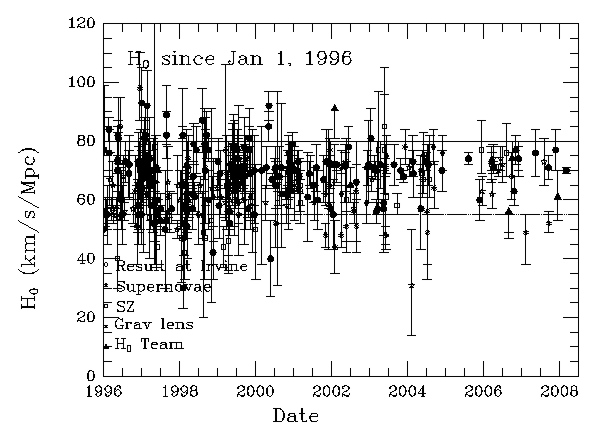
From THE HUBBLE CONSTANT by John P. Huchra.
Original article: by R. Brent Tully arXiv:2305.11950
“As the 20th century came to an end, ladder measurements of the Hubble constant were at odds with the favored cosmological model of the time of cold dark matter with Λ = 0. The new favorite became the ΛCDM model with dark energy giving rise to acceleration of space in a topologically flat universe. Yet ladder measurements, continuously improving, create doubts that this currently favorite model is complete. Yes, there is a Hubble tension.”
Here I am, Louis. Thanks for formatting my response to ACG mail properly. I will do it myself next time. Have a good day. Good answer anyway.
Han