
Update
I made a new video to describe the hypothesis:
https://www.youtube.com/watch?v=lVoHmVafTns
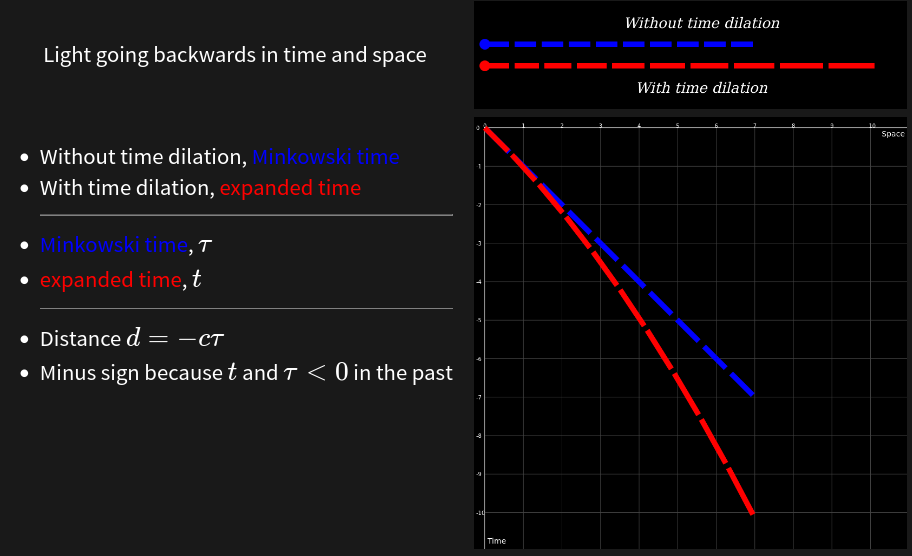
One change from before is calling it “expanded time” instead of “measured time”, based on input from Han.
Original
Time dilation is observed in supernovae and quasars.
https://arxiv.org/abs/2306.04053
Clocks at cosmological distances are observed to run slower. This is backed by empirical facts.
This basically rules out any type of tired light theory. It seems this leaves only expansion as a viable interpretation of redshifts and time dilation.
But maybe there is a third option. it’s not the space that expands, or the light that gets tired, it’s that time is dynamic.
Think about it, there’s only really three ingredients. You’ve got space, you’ve got time, and you’ve got light. Somehow light gets redshifted from place to another. Of those three options, dynamic space, dynamic light, dynamic time, the thing we actually observe is time dilation.
An electromagnetic wave gets redshifted when you stretch it in space. Longer wavelength.
But it also gets redshifted if you stretched it in time. Longer period, lower frequency.
So… what if redshifted light…. is time dilated light?
I mean… it almost has to be, if it’s coming from a place where time dilation is observed, why shouldn’t it be observed in the light?
So my hypothesis can be summed up as “the past is time dilated”. Space might be static, but time isn’t. And it isn’t observed to be. It keeps running faster. That’s why ancient light is running slower, ie, redshifted.
…
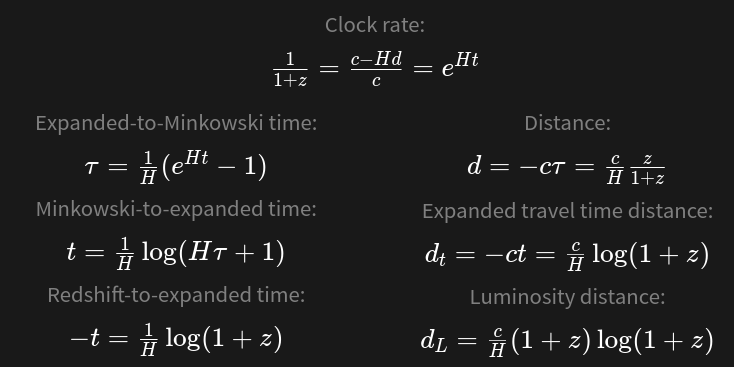
Using this I can get a luminosity distance - redshift relation:
$$d_L = \frac{c}{H_0} (1+z) \log (1+z)$$
that seems to fit the supernovae data.

Here’s a video I made that covers what I’ve said here and more. Maybe this could make it onto the website?
It rules out most tired-light models, but not mine!
Thanks for the response.
I’ve got your 2018 redshift review paper in my files. Nice work on that. It seems the closest entry in that work to my hypothesis would be the “spatial change of the flow of time” idea. But obviously they are fundamentally different.
How does your idea account for time dilation? It’s not described in the paper you linked.
For a supernova at z=1, the supernova will last twice as long as one that would have occurred in our galaxy. How do you account for the factor of 2?
Also, what do you think of the “time dilated past” hypothesis? We observe it to be time dilated. Maybe it is?
@mikehelland
Stimulated transfer interactions occur at a very slow rate in intergalactic space, causing a delay between the redshift of a spectral component and its redshifted version. That delay adds up each time a redshift interaction occurs on an electron and the cumulative delay stretches light curves (by a factor of z+1). I had not calculated that effect yet when I wrote the paper in 2009.
I don’t subscribe to variable time dilation in the past. I have spent a career working with atomic clocks and mechanical artifacts that can measure time to 19 significant digits. I’ve never seen any indication that time might be variable.
I don’t think a changing rate of time is something you’d detect in this hypothesis, unless you were observing something very far away.
Physical processes will always occur at the same rate according to a local clock. My hypothesis isn’t saying that clocks speed up while physical processes stay the same, so they slow down compared to the clock.
It’s saying all physical processes are speed up, including clocks. Such that the fundamental constants are always measured the same on any local clock in any epoch.
… except photons coming from a great distance, right?
Right, because whatever emitted those photons, already happened.
In the context of your hypothesis consider this situation: A helium atom, produced at the centre of the sun, travels from the core up to the surface, where we can see it from Earth.
Whatever emitted the helium atom already happened one billion years ago, so would the atom’s oscillations “speed up” or remain the same like old photons and have its original slow oscillations?
That’s an interesting take on things.
My first thought would be that they aren’t actually equivalent like that. The oscillating of an atom is on going physical process. The crests of an electromagnetic wave just propagate information about physical processes at one point in spacetime to another point spacetime.
Second thought is… well, assuming a helium atom upon being fused together were somehow immediately isolated. Would it still be ringing at the same frequency if we went to check on it 1 billion years later?
You don’t have to travel to the sun for observing the “ringing” of something that were somehow immediately isolated. From Shrinking Kilogram Bewilders Physicists we quote >A kilogram just isn’t what it used to be. The 118-year-old cylinder that is the international prototype for the metric mass, kept tightly under lock and key outside Paris, is mysteriously losing weight - if ever so slightly.
Were slightly means 50 micrograms. More details are found here. According to the Variable Mass Theory we have, with meaning of the symbols as in previous writings and $T_0-A$ = age of the earth:
$$ \frac{m}{m_0} = \left[1+\frac{T-T_0}{T_0-A}\right]^2 \approx 1+2\frac{T-T_0}{T_0-A} $$
$$ \frac{m-m_0}{m_0} \approx \frac{2 \times 118}{4.54 \times 10^9} \approx 52 \times 10^{-9} $$
Which is indeed approximately 50 micrograms when compared with the standard Kilogram.
Has the standard kilogram really been shrinking? No! Thanks to its splendid isolation it has remained constant all the time. But all matter around it has been suffering from Increasing Mass. Due to its interaction with the cosmos it has become heavier, with the amount as calculated.
@mikehelland
That’s my question, what’s your answer?
I don’t know for sure. Not knowing much about atomic physics, if a helium atom were produced through fusion, does it get “born” with an excited state? And if it did, wouldn’t it naturally, according to standard physics, eventually reach a ground state? How long does that take?
If we checked on a helium atom 1 billion years after it was born an excited state we should find that it is indistinguishable from a helium atom born yesterday (assuming they’ve both made it to a ground state… assuming ground state means what I think it means).
The atom stays together through, according to my limited understanding of standard physics, the constant exchange of virtual photons between the electrons and the nucleus.
So that’s an ongoing physical process.
If the helium atom emits a photon, it happens and its over, and information about that propagates through space over time.
The propagation of the light is an ongoing physical process. The speeding up of time would affect the light, faster clocks now would measure a lower frequency than the slower clocks then (time of emission).
If clocks run at 1/(1+z) speed, so at z=0 is 1 and at z=1 it’s 1/2, then the speed of light is c/(1+z).
At z=1, light is running at half speed compared to our clock. But clocks back then were running at half speed too, so the speed of light was still c according to clocks back then.
Does that make sense?
It’s simpler than you think. No atomic physics is needed here, only nuclear reactions. Helium nuclei are produced through fusion and they reach the ground state within femtoseconds. The oscillation frequency of the nucleus $\nu = M_{He}c_{old}^2/h$ is proportional to the mass of the nucleus $M_{He}$, with $c_{old}$ the speed of light billions of years ago and $h$ Planck’s constant. Only nuclear reactions can excite or destroy the helium nuclei, so by the time a nucleus has moved outside the centre of a star it remains the same because the temperature or pressure are no longer high enough for nuclear reactions to occur. The nucleus propagates freely like light, over billions of years, but at a slower speed.
The nucleus mass is an initial property of the nucleus, exactly like the photon frequency is the initial property of the photon. We know the mass of a He nucleus, and we know the frequency of a Lyman-alpha photon, both at the time of their production billions of years ago. This gives us two clocks from the distant past.
You claim that clocks today are faster, therefore when measuring the frequency of an old photon “faster clocks now would measure a lower frequency than the slower clocks then (time of emission)” So the old Lyman-alpha photon has a lower frequency (redshifted) when measured with today’s clocks.
My question is: Based on your model of “speeding up of time”, shouldn’t the frequency of an old helium nucleus also appear different when measured with today’s clocks?
How are we measuring the frequency and mass of a helium nucleus?
That frequency cannot be measured with nowadays (and future) equipment. There exists a natural bound on what can be accomplished with atomic clock time measurement: the Compton time. For an electron it is equal to $h/(m_e c^2) \approx 0.81\times 10^{-20}\mbox{ } s$. Atomic clocks can never be more accurate than this (nowadays $\approx 10^{-18}$). Considering helium, its nucleus is several thousand times the mass of an electron; therefore measuring $\nu = M_{He}c_{old}^2/h$ is purely hypothetical. There are no nuclear clocks yet anyway.
From Retrocausality we quote. Ernst Stueckelberg, and later Richard Feynman, proposed an interpretation of the positron as an electron moving backward in time, reinterpreting the negative-energy solutions of the Dirac equation. Moving backward in time. This means negative time ticks $h/(m_e c^2)$ , which can only be accomplished by a negative mass $m_e$ for the positron. So antimatter must have negative mass. However, antimatter has no negative mass, as has been concluded by @RedshiftDrift and myself in “Observation of the effect of gravity on the motion of antimatter”. Contradiction.
Basic experimental physics from the last century. Mass is measured by how much acceleration is observed in an electric field and calculated with $\vec{F} = M_{He} \ \vec{a} = q\vec{E}$. Or, the force can be generated by a magnetic field $F = q\vec{v} \times \vec{B}$.
Frequency $\nu$ is obtained from diffraction off a crystal and the de Broglie wavelength $\lambda = hvM_{He}$1. Then $\nu = v/\lambda$.
Your model does not give any prediction for such measurements on old helium.
Where here $M_{He}$ is the total mass of the nucleus and the two electrons of a helium atom, the same as the mass of the nucleus to within 0.1%.
Well, the helium emits some photons, and those photons travel for billions of years before we detect them, then we are measuring old helium.
If helium emits some photons today, the time at which the nucleus was fused together shouldn’t be particularly relevant. Maybe I’m just writing off your criticism, and there’s a problem here. It’s an interesting line of questioning though.
In our version of the Variable Mass Theory according to Halton Arp’s Ideas there are two time scales. Both of them are measurable. And both of them are actually measured in practice.
The (relative to now $=0$) period $\Delta t$ of Atomic clocks is dependent on variable mass $m$ according to $\Delta t/\Delta t_0 = m_0 / m$ . The (relative to now $=0$) period $\Delta T$ of Orbital clocks is dependent on variable mass $m$ according to $\Delta T/\Delta T_0 = \sqrt{m_0 / m}$ .
It seems that your theory, as displayed in the slides, is very analogous to mine. Details are found in A Basic Equation. Yours is on the left / mine is on the right in:
$$ \tau = \frac{1}{H_0}\left(e^{H_0t}-1\right) \quad \Longleftrightarrow \quad 1+\frac{1}{2}H_i(T-T_0) = e^{H_i/2.(t-t_0)} \quad \mbox{with} \quad H_i = \frac{2}{\mbox{age}} $$
$$ t = \frac{1}{H_0}\log\left(H_0\tau+1\right) \quad \Longleftrightarrow \quad \frac{1}{2}H_i(t-t_0) = \ln\left[1+\frac{1}{2}H_i(T-T_0)\right] $$
It’s not difficult to establish relationships. Therefore I am puzzled by your distance-redshift formula on the left, mine on the right:
$$ d_L = \frac{c}{H_0} (1+z) \log (1+z) \quad \Longleftrightarrow \quad D = \frac{c}{H_i}\ln(1+z) \quad \mbox{???} $$
Thanks for the response, I watched that video on Variable Mass Theory.
You’ve likely heard of a recent paper (maybe you were involved?) that suggests the expansion of the universe is a mirage:
https://bigthink.com/starts-with-a-bang/expanding-universe-mirage/
So instead of the standard way of viewing cosmology, you can instead formulate your Universe as static and non-expanding, at the expense of having:
all change and evolve. Because the goal is to keep the structure of the Universe constant, you can’t have expanding, curved space that has growing density imperfections within it, and so those evolutionary effects need to be encoded elsewhere. Mass scales would have to evolve across spacetime, as would distance scales and timescales. They would have to all coevolve together in precisely such a way that, when you put them together to describe the Universe, they added up to the “reverse” of our standard interpretation.
I think that this might be similar to my idea, but quite a bit more convoluted. Ultimately, just changing time alone leads to things looking slower and heavier. And ultimately, changes in the flow of time are what is directly observed.
To answer your question about distances, the physical distance to galaxies in my model is:
$$d = \frac{c}{H_0} \frac{z}{1+z} $$
As the photon travels that distance each step of the way will be time dilated by the z of that step, being fully time dilated . If z=1, the light’s journey will be time dilated by 2 (which is 1+z) near the source, and 1 (so not time dilated at all) near the observer. That makes the ct (the light travel time distance):
$$d_T = \frac{c}{H_0} \log (1+z) $$
In order to compare this to measurements (such as Pantheon+SH0ES) we need a distance modulus, which means we need a luminosity distance. To get that I just slap a (1+z) on the light travel time distance:
$$d_L = \frac{c}{H_0} (1+z) \log (1+z) $$
That provides a natural fit for the data, and a better fit than LCDM.
That paper seems to remain “recent” forever: The expansion of the universe could be a mirage, new theoretical study suggests. Déjà vu all over the place: The Universe’s Expansion May Just Be An Illusion, New Paper Suggests However, the truth is that we are talking about an old theoretical study that has already been published in a 1992 paper by Jayant Narlikar and Halton Arp. Which by the way is not found in the reference list as given by Lucas Lombriser.
General Relativity is not needed at all for a derivation of the most relevant results. See here: Mathematicists find new glasses.
$$ \Large\frac{m}{m_0}=\left[1+\frac{1}{2}H(T-T_0)\right]^2=\frac{(T-A)^2}{(T_0-A)^2}\quad\mbox{with}\quad H=\frac{2}{T_0-A} $$
Well, this summer. That’s fairly recent.
There is no Cosmic Fine Tuning if that is what you’re suggesting. Let $m=$ mass, $H=$ Hubble parameter $=2/\mbox{age}$ , $L=$ length, $t=$ atomic time, $T=$ orbital time, $_0=$ here and now.
That’s a satisfactory answer. Thanks! My distance definition thus concerns $d_T$ and not $d_L$ .
@mikehelland .
You wrote: >Well, this summer. That’s fairly recent.
I wrote: >theoretical study that has already been published in a 1992 paper
Well, 1992. That’s fairly old.
Now compare this formula of yours (on the left) with formulas in one /two / three references from 1936 (on the right):
$$ t = \frac{1}{H_0}\log\left(H_0\tau+1\right) \quad \Longleftrightarrow \quad \tau = t_0\log(t/t_0)+t_0 $$
What do you think ?
Well, if you plug in τ=0 for the one on the left (mine), you get t=0.
On the right hand side, you plug in t=0, you get out -infinity?
They look similar, but they’re not same. I think the one on the right comes from space being hyperbolic. Is that right?
Not only this. You also get:
$$ \frac{dt}{d\tau}(\tau=0) = 1 $$
Meaning that your $t$ clock and the $\tau$ clock are fully synchronized for timestamp (0). Question: who does the synchronizing ? Are there absolute beginnings of the two time scales in your theory ?
That’s correct. The reason is that in Milne’s theory there are other “beginnings” than in your theory. To see this, substitute $H=2/(T_0-A)=2/\mbox{age}$ ; remember that $t_0=T_0$ :
$$ \frac{1}{2}H_i(t-t_0) = \ln\left[1+\frac{1}{2}H_i(T-T_0)\right] \quad \Longleftrightarrow \quad (t-A)-(T_0-A) = \frac{1}{T_0-A}\ln\left[\frac{T-A}{T_0-A}\right] $$
And again
$$ t = \frac{1}{H_0}\log\left(H_0\tau+1\right) \quad \Longleftrightarrow \quad \tau = t_0\log(t/t_0)+t_0 $$
So these are the relationships - hope I’ve made no mistakes:
$$ \begin{cases} \mbox{Milne’s} & \mbox{mine} & \mbox{yours} \ 1/t_0 & H_i/2 & H_0 \ t_0 & T_0-A & 1/H_0 \ t & T-A & \tau+1/H_0 \ \tau & t-A & t-1/H_0 \ \log & =\ln = & \log \ t=0 & T=A & \tau=-1/H_0 \ \tau=t=t_0 & T=t & t=\tau=0 \end{cases} $$
t=0 is the present.
t represents a real clock, and is the actual time measured by an observer.
τ represents a hypothetical clock where the effects of time dilation are removed.
So say z = 1 and t = -9.7 billion years.
If you remove the effects of time dilation, it becomes -7 billion years. You get that by multiplying each moment of the -9.7 billion years by 1/(1+z). So the first moment is multiplied by 1/(1+z) at z=1, so 0.5. The last moment is z=0, so that’s multiplied by 1. Integrating 1/(1+z) gives you log(1+z), and that’s the natural log, by the way, so ln(1+z).
So they are synchronized at 0 by virtue of 0 being the present where there is no time dilation. A duration of 0 simply can’t be time dilated.
I’ve been reading this several times, but your reasoning escapes me. I do understand the first and the last step but I see no in-betweening that justifies Integrating 1/(1+z) gives [ .. ], so ln(1+z). Perhaps I am too much of a (would-be) mathematician. Can you please provide a few more details?
Meanwhile I’ve been trying to reproduce your results. I did it my way. Can you confirm or deny? Any of the two will be appreciated. Take a look at the figure, depicting distances in cosmic space back in time. Let $\lambda=$ wavelength of light. Then it is obvious that:
$$ \frac{\lambda_1}{\lambda_0} \frac{\lambda_2}{\lambda_1}\frac{\lambda_3}{\lambda_2} \frac{\lambda_4}{\lambda_3} = \frac{\lambda_4}{\lambda_0} $$
And therefore, by definition of $z_{ab}=(\lambda_b-\lambda_a)/\lambda_a$ :
$$ 1+z_{04} = (1+z_{01})(1+z_{12})(1+z_{23})(1+z_{34}) $$
Let’s continue this ad infinitum, oh well, up to $N$ :
$$ 1+z = 1+z_{0N} = (1+z_{01})(1+z_{12})(1+z_{23})(1+z_{34}) \cdots $$
Taking the increments in $z$ all equal and infinitesimally small we get:
$$ 1+z_{0N} = (1+dz)^N \quad \Longrightarrow \quad \ln(1+z) = N\ln(1+dz) $$
Employing $\ln(1+dz) = dz$ and Hubble’s law $dz = H_0.dt$ for (relatively) small cosmic distances we get:
$$ \ln(1+z) = N\ln(1+dz)=H_0(N.dt) = H_0 t $$
I think you are proposing the original (linear) Hubble’s law $z=H_0\tau$ for “measured” time and so, finally:
$$ t = \frac{1}{H_0}\ln(1+z)=\frac{1}{H_0}\ln(H_0\tau+1) $$
Is the above correct understanding of your theory?
I think its pretty close. I think it should be:
$$- \frac{z}{1+z} = H_0 \tau $$
We define redshift has a positive number, the ratio of an increasing wavelength (or decreasing frequency).
$$ 1+z = \frac{\lambda_{obs}}{\lambda_{emit}} = \frac{f_{emit}}{f_{obs}} $$
Redshift is z > 0 up to infinity. What is blueshift? Well, blueshift is negative, but you can only go down to -1. For z=-1 either the wavelength observed, or emitted would be zero, which is nonsense.
If you flip the situation around, and give redshift the negative numbers, -1 to 0, by doing this:
$$ 1+ b = \frac{1}{1+z} = \frac{\lambda_{emit}}{\lambda_{obs}} = \frac{f_{obs}}{f_{emit}} $$
According to this b > 0 up to infinity is blueshift, and -1 to 0 is redshift.
$$ b = \frac{1}{1+z} - 1 = -\frac{z}{1+z} $$
For z = 1, b = -0.5. For z = 2, b = -0.6666. For z = 9, b = -0.9
You get the idea.
-b is directly proportional to frequency, energy, and, in my theory, physical distance, as well as the “un-time dilated” lookback time, which is just c * distance. So:
$$ d = -b \frac{c}{H_0} = \frac{z}{1+z} \frac{c}{H_0} $$
(FWIW, this is the same as the angular diameter distance in an exponentially expanding universe.)
To be honest, you actually lost me at your first equation.
What I was thinking is that if something happened at z=1, that took 1 second to an observer then and there, then we would observe it to happen as 2 seconds. If something happened at z=0.9 that lasted one second, to us it would would last 1.9 seconds. At z=0.8? 1.8 seconds.
Now imagine a photon traveling from z=1 to z=0. If we were to say that, without time dilation, this journey would take 7 billion years, how long is it after time dilation?
That’s where the integral came in.
$$ -\frac{z}{1+z} = H_0 \tau \quad \Longleftrightarrow \quad H_0 \tau+1 = \frac{1}{1+z} $$
So I’ve got it wrong. Yes, the redshift (plus one) is of course inversely proportional as
(measured)Minkowski time proceeds from $-1/H_0$ to now $=0$. And for $\tau \gt 0$ we have a blueshift as long as $-1\lt z\lt 0$.Right?I think the first part of my equations is good (though maybe not useful). It only becomes slippery here: >Employing $\ln(1+dz) = dz$ and Hubble’s law $dz = H_0.dt$ for (relatively) small cosmic distances we get:
Let’s skip that questionable part for LATER. >and so, finally:
$$ t = -\frac{1}{H_0}\ln(1+z) = \frac{1}{H_0}\ln\left(\frac{1}{1+z}\right) = \frac{1}{H_0}\ln(H_0\tau+1) $$
where there is redshift for
(Minkowski)Measured time $t \lt 0$ and blueshift for $t \gt 0$ .Right so far?Really close. Measured time is $t$ and Minkowski time is $\tau$. (See graphic in top post.)
The idea is our measured time includes time dilation.
Minkowski time is what you’d get if you took out the effects of time dilation.
So, if z=1 gives a lookback time of 9.7 billion years (which is really t = -9.7 billion years) if we take out the time dilation, we should get a smaller number. So $\tau$ = -7 billion years.
This means the farthest we can look back, at z = infinity, is $\tau = -1/H_0$ without the effects of time dilation. With time dilation t = -infinity. The farthest distance we can see is $c\tau$ or $c/H_0$,
I still have a hard time trying to understand all details of your Time Dilated Past theory. Especially the in-betweening: >That’s where the integral came in.
Working backwards and re-reading your postings for the N-th time I think that the following must be true.
$$ -dt = \frac{1}{H_0}\frac{dz}{1+z} $$
In words: Measured time decrement ~ redshift increment divided by (one plus redshift). Is that correct?
Well, the integral part might be a red-herring.
How do you get from undilated time to dilated time, or vice versa?
It seemed to me you add up all the small time dilations that happen.
$$ \int_0^z \frac{1}{1+z} = \log (1+z)$$
But maybe that’s not right.
In any case, I think your formula might be:
$$ -dt = \frac{1}{H_0}\left( \frac{1}{1+dz} - 1 \right) $$
Let’s do it this way, as I found out last night.
$$ t = \frac{1}{H_0}\ln\left(\frac{1}{1+z}\right) \quad \Longrightarrow \quad dt = -\frac{1}{H_0}\frac{dz}{1+z} $$
$$ H_0\tau+1 = \frac{1}{1+z} \quad \Longrightarrow \quad d\tau = -\frac{1}{H_0}\frac{dz}{(1+z)^2} $$
Combining the two gives
$$ dt = (1+z).d\tau $$
In this way the Measured time tick is indeed a time dilation of the Minkowski time tick with the Time Dilated Past hypothesis. The Variable Mass Theory gives a slightly different outcome, namely
$$ \frac{dT}{dt} = \sqrt{\frac{m}{m_0}} \quad \mbox{with} \quad 1+z = \frac{\lambda}{\lambda_0} = \frac{m_0}{m} $$
And so
$$ dt = \sqrt{1+z}.dT $$
Fortunately, we use the same symbol for Measured Time = Atomic Time. But Minkowski Time $\tau$ is not the same as Orbital Time $T$. Nevertheless we both arrive at similar formulas by joining the two time scales. Consistency check:
$$ t=\frac{1}{H_0}\ln\left(\frac{1}{1+z}\right)=\frac{1}{H_0/2}\ln\left(\sqrt{\frac{1}{1+z}}\right)=\frac{1}{H_0/2}\ln\left(H_0/2.T+1\right) $$
$$ H_0/2.T+1=(1+z)^{-1/2} \quad\Longrightarrow\quad dT=\frac{1}{H_0/2}(-1/2)\frac{dz}{(1+z)^{3/2}} $$
$$ dt=-\frac{1}{H_0}\frac{dz}{1+z} \quad\wedge\quad dT=-\frac{1}{H_0}\frac{dz}{(1+z)\sqrt{1+z}} \quad\Longrightarrow\quad dt=\sqrt{1+z}.dT $$
For values much smaller than the Hubble time the different time spans cannot be distinguished from each other:
$$ \left(\frac{1}{2}H_0 T+1\right)^2=H_0\tau+1=e^{H_0 t} $$
$$ 1+H_0 T \approx 1+H_0 \tau \approx 1+H_0 t $$
And all time scales share the same value for the Hubble parameter.
@mikehelland . As far as I am concerned, we are done. Time Dilated Past is a fantastic theory !! The relationship with our Variable Mass Theory finally has become entirely transparent (at least for me). It has therefore become possible for us to (mis)use all of the results you shall achieve with working on astrophysical data. For me the latter is something I cannot even dream about 🥴
Didn’t Eric Lerner touch on the issue of apparent time dilation in objects like Quasars and Type Ia Supernova in some of his article? I believe others have touched on the issue too (some of whom even Lerner cited in his own papers).
Lerner’s articles on time dilation of SN Ia light curves (this one for example) are based on an analysis made by Crawford. The analysis made by Crawford was specifically designed to avoid the assumption of expansion, but as a result the conclusions are ambiguous: there could be expansion or not. Eric Lerner picked the interpretation that is favourable (no SNe dilation) to his work, but he did not demonstrate that the other interpretation (SNe dilation) has to be rejected.
I had a personal discussion with Eric about this, but we never reach agreement due to our different view on what causes the redshift.
I wonder if you could expand on that. It’s not obvious to me why that would rule out tired light. My working hypothesis for a long time has been that time dilation is seen wherever a redshift occurs. Can you (or anyone) think of a case where this is proved false? The first prediction of time dilation in supernovae was based on just the ordinary Doppler effect. Then it became the relativistic Doppler. Finally, it was the expansion of spacetime.
We did talk about Vaclav Vavrycuk’s model briefly here, but I can’t see the thread now. Here is the link again: https://www.frontiersin.org/articles/10.3389/fphy.2022.826188/full
Vavrycuk suggests like you do that a time dilation term should be added. He adds it to the FLRW metric and by so doing he argues that supernova time dilation can be explained without dark energy. However, my conjecture would be that adding the time dilation term merely cancels the effect of expansion in FLRW and that by dropping both you could also get supernova time dilation without dark energy.
There is no conceivable scenario where two photons leave a source 1 second apart and arrive 2 seconds apart if distances aren’t changing.
Something special would have to happen to one of the photons (other the first one finds a short cut or the second one gets delayed by something that doesn’t affect the first one).
Feel free to change on my mind on that one.
The time dilated hypothesis says that the photons arrive two seconds apart (according to our clock) because they left two seconds apart (according to our clock).
Clocks back then (say z=1) were running at half speed. So an observer there and then would think the photons left 1 second apart.
That is the interpretation favored by the time dilated past hypothesis. Time dilation (which is observed) is what is happening. Time dilated EM waves are redshifted EM waves. The expansion of space can be discarded.
Vavrycuk’s ideas are actually much more interesting than mine. He’s saying that if you were to go back in time, when the universe was smaller, and thus denser, it would be like getting closer and closer to a black hole. He says that rather than an invariant cosmic time (as FLRW demands), that GR is at its best when time does vary. So he’s using the expansion of the universe (contraction in reverse) to make clocks run differently. Interesting stuff. I don’t think its right (I’m a proponent of my nonexpanding model), but fun stuff anyways.
Just to clarify, time dilation of supernovae happens in an expanding universe with or without dark energy.
The SN measurements allow us to extend our distance ladder out to z ~ 2. When taken together (about 1700 different SN) we get a Hubble diagram. An FLRW model with just matter and no dark energy doesn’t fit the data. An FLRW model with ~70% dark energy does.
I made a video about that here:
https://www.youtube.com/watch?v=z35NtpI58Qk
I can think of at least one. Consider a wave train of light traveling from a source through space to a detector. Suppose that the tired light redshift is caused by photons doing some sort of work in moving through spacetime (gravitational work, for instance). Then at each point in space the photons in the leading edge of the wave will have done more work and have been subjected to a greater redshift than those in the trailing edge. The whole wave train will then progressively lengthen and the time between individual photons arriving at a detector will be increased.
Keep going though.
If the photon A has done more work when it hits the detector because it’s traveled farther than photon B, what happens when photon B hits the detector? It will have done the same amount of work and traveled the same distance as photon A. Their time in-flight will be equal, and thus their separation at arrival will always be their separation at departure.
EDIT: not an expert in this field. Merely posting an observation and question. Accept my opinion with caution :)
The rate at which photons arrive is measured as flux/intensity and does not have a bearing on redshift. For space to be expanding, the photon intensity must weaken AND the photon energies must redshift. For both sets of SNs and Quasars the intensities and redshifts are used.
In the case where photons do work, a redshift will be observed since each photon may lose energy. The spacing does not need to change and you will still measure redshift. But you should not observe a loss of flux/intensity (with photon energy loss already accounted for).
Since our distance scales for both sets SNs and quasars are also based on intensity (but mostly redshift), how do we distinguish if intensity loss is due expansion or just mere extra distance?
@ExpEarth . >My working hypothesis for a long time has been that time dilation is seen wherever a redshift occurs.
Right !! We could not agree more on this issue. 😀
I’ve been in administration, so here it is.
To answer @ExpEarth ’s question in that other thread, if you express the metric with only time dilation:
$$ ds^2 = -c^2 a(t)^2 dt^2 + dx^2 + dy^2 +dz^2 $$
It turns out that since only the time coefficient is changing, and it’s changing with respect to time, the Riemann curvature tensor is zero. A physicist looks at this and says you’re scaling the time coordinate, but the underlying manifold itself is unchanged, and equivalent to Minkowski spacetime, where no time dilation or redshift occurs. Been down that road…
@mikehelland
I am sort of in between on hypotheses of what causes time dilation in SNe and quasars. I see your point, but the situation can get more complicated than that. For example, tired light models also have to account for the temperature-redshift relation in the CMB. I have argued that this can only be accounted for in a TL model if spacetime itself has a photonic structure. This allows the photon number, etc, in the CMB to be mediated by spacetime, in such a way that the CMB can remain as blackbody at all points. In that case, the two photons in my example may not even be the same photons by the time they reach the detector! By the way I saw two of your interesting videos and you asked viewers what to talk about next. I would suggest the CMB.
Thanks so much for answering my question! But is it not true that spacetime does appear as flat and Minkowski wherever we look? The Big Bang people are troubled by it, but if we suppose that the universe is not expanding should we not be happy to find a Minkowski spacetime? The question then is what causes the time dilation in distant objects. It may not be so clear cut a distinction between TL, gravitational redshift or your intrinsic tile dilation hypothesis.
Taking your hypothesis, we can ask what is causing time to change? Could we rephrase it by linking it to the speed of light? Then, rather than saying time was slower in the past, we could say that the speed of light is slower at great distance. This would give the time dilation, since events would occur at longer intervals. At the same time, as a photon moves closer to us its speed would increase and its wavelength also increase, giving the Hubble redshift. If we were to go that route, we could then ask why the speed of light should be slower at high redshift. I would suggest this is because spacetime itself is denser there - think of it as being photonic in nature. To answer why spacetime density would be higher at those distances I would then argue for my cosmological model which sees the universe as a black hole-type object. But let me stop here for the moment.
Thank you so much for the feedback!
Not so much, because, there’s no (accepted as) valid explanation for cosmological time dilation.
You’ve still got your time dilation in special relativity, but that can’t apply here: at high enough z (z~1.6) galaxies are moving away from us at the speed of light, which with 1-v/c all over the place ends up putting divide by zero errors everywhere. In your original comment you said:
And this is the reason. At v=c not even relativistic Doppler gives sensical answers. The Friedmann equations do.
There is another reason time dilation can’t be a simple result of geometry, such as in the Doppler effect. A supernova at z=1 should be time dilated by a factor of 2. For it to be time dilated by a factor of 2, it has to be moving away from us at c. Ignoring the fact that when v=c we get those divide by zero errors, in LCDM, the galaxy at z=1 isn’t even moving at c at the time the light is emitted. So even if the equations did work at that recession velocity, it’s not actually the recession velocity. v=c in LCDM at about z=1.6.
This is more or less what the time dilated past hypothesis is.
Let’s say you have z=1 on the left and z=0 on the right.
1––––0
And light travels from z=1 to z=0.
The light will pass a new clock every step of the journey that will be running faster than the clock before it. The photon is always moving at c when measured on the nearest clock.
But, if we compare its speed to our clock at z=0, then its speed is actually c/(1+z). Meaning its moving slower in the past, and gaining speed (and wavelength) until it reaches us at z=0 where its moving at c.
If you’re just changing the speed of light though, you have a similar problem that you had with your light train. Say photon A and B leave z=1 separated by one second. And say they leave at c/2 and arrive at c. The distance between photon A and photon B will be continually increasing. But when A meets the detector B is left alone to do its catching up. The time in-flight from source to detector for each photon will be equal. They will thus arrive one second apart, just as they left.
On this point, I was not intending to mean that the changing speed of the traveling photon is causing the time dilation. Rather, if c is reduced at the distant source the events at that position would be spread out in time, giving the observed time dilation.
If the speed of light were the only thing different, physics would be very different in those epochs. Is that what you’re suggesting? Or would physics still work the same (ie, experiments give the same outcome today as 10 billion years ago)?
If the latter, then that is what the paper referenced in several other places is saying:
https://iopscience.iop.org/article/10.1088/1361-6382/acdb41
“Rather than an expansion of space, spatial curvature, and small-scale inhomogeneities and anisotropies, this frame exhibits a variation of mass, length and time scales across spacetime. Alternatively, this may be interpreted as an evolution of fundamental constants.”
So if the speed of light were different, and everything else was too, then physics would still be the same.
My idea changes time and leaves everything else alone.
I think Occam’s razor would prefer simply changing the rate that time passes (which is actually observed) to changing all the fundamental constants in-concert (which isn’t observed).
I was meaning more in the first sense, of just the speed of light changing. (Thanks for the interesting paper, though!) If we were to define time as length divided by c , and want to hold lengths constant, then the only way to increase times is to reduce c.
While I would agree with you that we don’t have any evidence for physical constants changing over time, the value for c could conceivably change at different points in space. Light speeds in optical media change without our having to invent new physics.
If the distant object is traveling closer to light speed the time of the object is slowing down
Until recently I had the misconception that time dilation in an expanding universe could be understood geometrically, like with the Doppler effect.
That doesn’t really add up, and I describe what I learned in this video, on how cosmic time dilation really works (in an expanding universe):
https://www.youtube.com/watch?v=gN8Q1R7pHHI
Coorect, everything starts out slower
A footnote by @RedshiftDrift in discussion 187 gives the following rather precise definition of a clock.
Question @mikehelland: where are these three necessary elements in your Minkowski time $\tau$ and expanded time $t$ ? (By the way, I found “measured time” not such a bad naming for $t$ but okay).
@HanDeBruijn
Hello, I made a little demo here to show some light clocks in this setup:
https://mikehelland.github.io/hubbles-law/other/lightclock.htm
Basically, if the light is traveling back and forth in a light clock at z=1, it will always be traveling at c/2.
If the light is traveling from z=1 to z=0, it will travel at all speeds between c/2 and c.
HanDeBrujin’s idea on time is interesting ad should be tested
What idea is that? Just curious, is this some type of chat bot?
@mikehelland
There exists a critical essay, written by Léon Brillouin at the end of his life. The title of the booklet is Relativity Reexamined. Quoting from page 33: Einstein’s clocks were supposed to emit extremely short signals and to accurately measure time intervals between signals emitted and received. In a word, an Einstein clock was a radar system, and its requirements were thus very different from those of a frequency standard. Your “light clock” is such a radar system. But okay, that’s not necessarily bad.
Question here is consistency. Let’s see, departing from the formulas we do agree upon.
$$ -t = \frac{1}{H}\log(1+z) \quad ; \quad \tau = \frac{1}{H}\left(e^{Ht}-1\right) $$
And so
$$ \tau = \frac{1}{H}\left(e^{H.-1/H\log(1+z)}-1\right) = \frac{1}{H}\left(\frac{1}{1+z}-1\right) = -\frac{1}{H}\frac{z}{1+z} $$
Hence - inevitably - the associated (Minkowski) distance is, indeed
$$ d = -c\tau = \frac{c}{H}\frac{z}{1+z} \quad \mbox{and} \quad 0 \le d \le \frac{c}{H} $$
There is an independent Cosmic distance ladder though. Are you sure that these distances are limited to the Hubble length $c/H \approx$ 14.4 billion light-years ?
Update
For the (HdB version of) the Variable Mass Theory we find analogously the following.
$$ -t = \frac{1}{H}\ln(1+z) \quad ; \quad \left(1+\frac{1}{2}H.T\right)^2 = e^{H.t} $$
And so
$$ 1+\frac{1}{2}H.T = e^{H/2.t} = e^{H/2.-1/H.\ln(1+z)} = e^{\ln(1/\sqrt{1+z})} = \frac{1}{\sqrt{1+z}} $$
Hence for the accompanying “Proper distance”:
$$ d_P = -c.T = \frac{2c}{H}\left(1-\frac{1}{\sqrt{1+z}}\right) \quad \mbox{and} \quad 0 \le d_P \le \frac{2c}{H} $$
Oh my, that is an interesting “coincidence” !! Let’s take a look again at slide 47 as displayed in thread 188. Then we see that
@HanDeBruijn
According to this model, yes. It’s more like 13.8, though. H = 70.4 km/s/Mpc.
This can be used to make predictions about how many galaxies we’ll find. Set $R = c/H$, then the volume of the observable sphere is:
$$\frac{4}{3} \pi R^3$$
Let’s then split that into 10 equal volumes. So we get something like this:
This tells us the number of galaxies between $1.41 < z < 2.03$ should equal the number of galaxies between $7.92 < z < 12.95$.
Maybe some database scrapping can get values for these ranges, and we can compare the predictions to observations.
FWIW, with Λ alone, FLRW doesn’t lead to a big bang. An exponentially expanding universe in reverse exponentially decays. It never reaches 0.
In that universe, the distance after expansion is $z\frac{c}{H_0}$. The distance before expansion (ie, angular diameter distance) is $\frac{z}{1+z}\frac{c}{H_0}$.
Finding similar equations in similar models does not form the basis of a scientific argument. The light travel time distance in the Milne model is $\frac{z}{1+z}\frac{c}{H_0}$ too. Coincidence? Not really, that’s how the math works. Is there anything meaningful in they’re being the same equation? No.
@mikehelland .
It’s easy to predict that any database scrapping will give you $\approx$ NULL $\approx$ galaxies between $27.98 \lt z \lt \mbox{infinity}$ .
Your data are reproduced by
If we double the number of shells to $N=20$ then the (normed)radius - redshift numbers become
According to the VMT the maximal observable redshift is $\approx 28.5$, so everything beyond $z=57.99$ is unobservable. This would mean that your setup with the number of galaxies between two $z$ values is not going to work.
Those are the predictions from the time dilated past hypothesis. I’m not sure what they would be for other theories (eg, LCDM, VMT, tired light), but we can say (in this model) that there should be the same number of galaxies between 0.58 and 0.87 as between 9.94 and 12.95.
I would suspect there’s some kind of extinction rate to take into account for. Which might be calculated by comparing the predicted number of galaxies for the range, and the number that are actually detected there.
I’m seeing something with those shells of equal galaxy number that could connect with both Hans’ and Mike’s hypotheses. Am just tossing this out there.
Suppose that the speed of light steadily diminishes with distance. It would thus be lowest at the most distant shell and (perhaps) highest near our position (supposing we are near the universe centre). In this case the masses of the atoms of the most distant galaxies would also be lower, from E = mc^2 . This could connect with Hans’ variable mass model. This would mean that the mass density of the outer shells is less than that of our ‘local shell’. Does this mean the total energy density of the outermost shells would also be less? This seems counterintuitive, as we might expect all shells to have the same energy density.
But wait. Let’s not forget the CMB. Assuming that its temperature rises with redshift distance, as we have discussed in other threads (though not agreed upon!), then the CMB energy density would be greatest at the most distant shell. In my own model I find that the CMB temperature would be about 29 K there (much less than the LCDM model predicts). The energy density of that CMB would be almost the same as the critical density in the LCDM model. So what it could be is that each shell has the same energy density, but the proportion of mass energy to CMB energy varies. So we could have redshift linked to time dilation and mass variation. The redshift could be classed as a tired light redshift, since the energy of the CMB photons would be going into increasing atomic mass energy. (This could cause gravity, by the way, but that’s another story!)
FWIW, in my model, light begins slower (since clocks run slower), at $c/(1+z)$, and picks up speed as time speeds up. It reaches us at $z=0$, therefore, moving at $c/1$.
@ExpEarth writes: >Suppose that the speed of light steadily diminishes with distance.
With the variable mass theory it is exactly the other way around. The speed of light steadily increases with distance, in some sense. Mathematically. With $t=$ atomic time, $T=$ orbital time and $H=$ (intrinsic) Hubble parameter we have
$$ \frac{1}{2}H.t = \ln\left(1+\frac{1}{2}H.T\right) \quad \Longrightarrow \quad \frac{dt}{dT} = \frac{1}{1+H/2.T} $$
On the other hand, with $m=$ variable mass and $_0=$ here and now, according to Narlikar’s law:
$$ \frac{m}{m_0} = \left(1+\frac{1}{2}H.T\right)^2 \quad \Longrightarrow \quad \frac{dt}{dT} = \sqrt{\frac{m_0}{m}} = \sqrt{1+z} $$
The speed of light $c$ (orbital) or $c_0$ (atomic) can be expressed with the two time scales. Let $s=$ distance, then
$$ c_0 = \frac{ds}{dt} \quad \mbox{and} \quad c = \frac{ds}{dT} = \frac{ds}{dt}\frac{dt}{dT} = c_0\sqrt{\frac{m_0}{m}} = c $$
According to the variable mass theory, mass is increasing with time. Therefore $c$ in the past has been larger than it is now, because of $m_0 \gt m$ , in some sense (: orbital frame). It follows that (mass)energy, as calculated within the orbital time frame, is conserved.
$$ \large \boxed{mc^2=m_0c_0^2} $$
You are saying this repeatedly. But, Matt, we are always in the centre of our own observable part of the universe. >So we could have redshift linked to time dilation and mass variation.
Yes, atomic clocks with lighter electrons run slower and send redshifted light.
Note.
From Relativity Reexamined by Léon Brillouin: >We witnessed the invention of atomic clocks of incredible accuracy, whose physical properties differ very much from the clocks Einstein imagined [ i.e. the “light clocks” as employed by @mikehelland ]. Let us mention here a real difficulty resulting from internationally adopted definitions. The unit of length is based on the wavelength of a spectral line of krypton-86 under carefully specified conditions with accuracy $10^8$ and the unit of time is based on the frequency of a spectral line of cesium with accuracy $10^{12}$. Hence, the same physical phenomenon, a spectral line, is used for two different definitions: length and time, and the velocity $c$ of light remains undefined and looks arbitrary. It should be stated, once and for all, whether a spectral line should be used to define a frequency or a wavelength, but not both!
Meanwhile, the evil has been done ! Spectral lines are used for both length and time. And thus defined these are associated with atomic time, not with orbital time. As a consequence, the lightspeed $c_0$ in the atomic timeframe is a constant by definition, not only here and now, but a universal constant. We have done it ourselves; it’s not a “law of nature”.
@mikehelland That is how I was seeing your model. I notice though that the way you have defined it could be used to describe two very different situations: time dilation in the past and time dilation at greater distances. We could have the latter without the former.
@HanDeBruijn I confess I don’t understand your model very well. But, as with Mike’s model, how are we to distinguish between mass changing with time and mass changing with distance?
Could you possibly put your model into an abstract form, like with a journal article, without the equations? This could help.
@ExpEarth
Indeed.
Trying to describe this as a metric tensor (which may or may not be necessary) I came up with:
$$ds^2 = -c^2 e^{2Ht} dt^2 + dx^2 + dy^2 + dz^2$$
And:
$$ds^2 = -(c-Hr)^2 dt^2 + dr^2 + r^2 d \theta^2 + r^2\sin^2 (\theta) d\psi^2$$
The first one describes the former and the second one the latter.
As we’ve talked about previously, the first one has time changing over time, which, in the parlance of differential geometry, means the metric is actually just distorted coordinates for a Minkowski spacetime, which doesn’t have redshift or time dilation. So, at least for those interested in general relativity, the latter does seem more palatable. There is the issue though that it only applies to an observer at $r=0$. Using the latter, our position in the universe seems to indicate that only our frame of reference runs at “normal” time. Time speeding up everywhere does seem to be more Copernican.
Alternatively, since the time dilation seems utterly oblivious to there being matter and gravity in the universe, maybe there is no logical connection to general relativity. It sure would be preferable to be compatible with it though.
@ExpEarth . >how are we to distinguish between mass changing with time and mass changing with distance?
The answer is: we don’t. Because with “measured time” $t$ we have for a distance $r$ that $r = -c.t$ where $c=$ lightspeed. >I confess I don’t understand your model very well.
Same holds for me too. I cannot understand somebody’s model without investing (much) time to study it. A good overview of (my humble version of) Arp’s theory may be found in thread 141. And then there is of course the website. >Could you possibly put your model into an abstract form, like with a journal article, without the equations?
You say that like with a journal article is putting the model into an abstract form ? And without the equations ? I do not copy.